
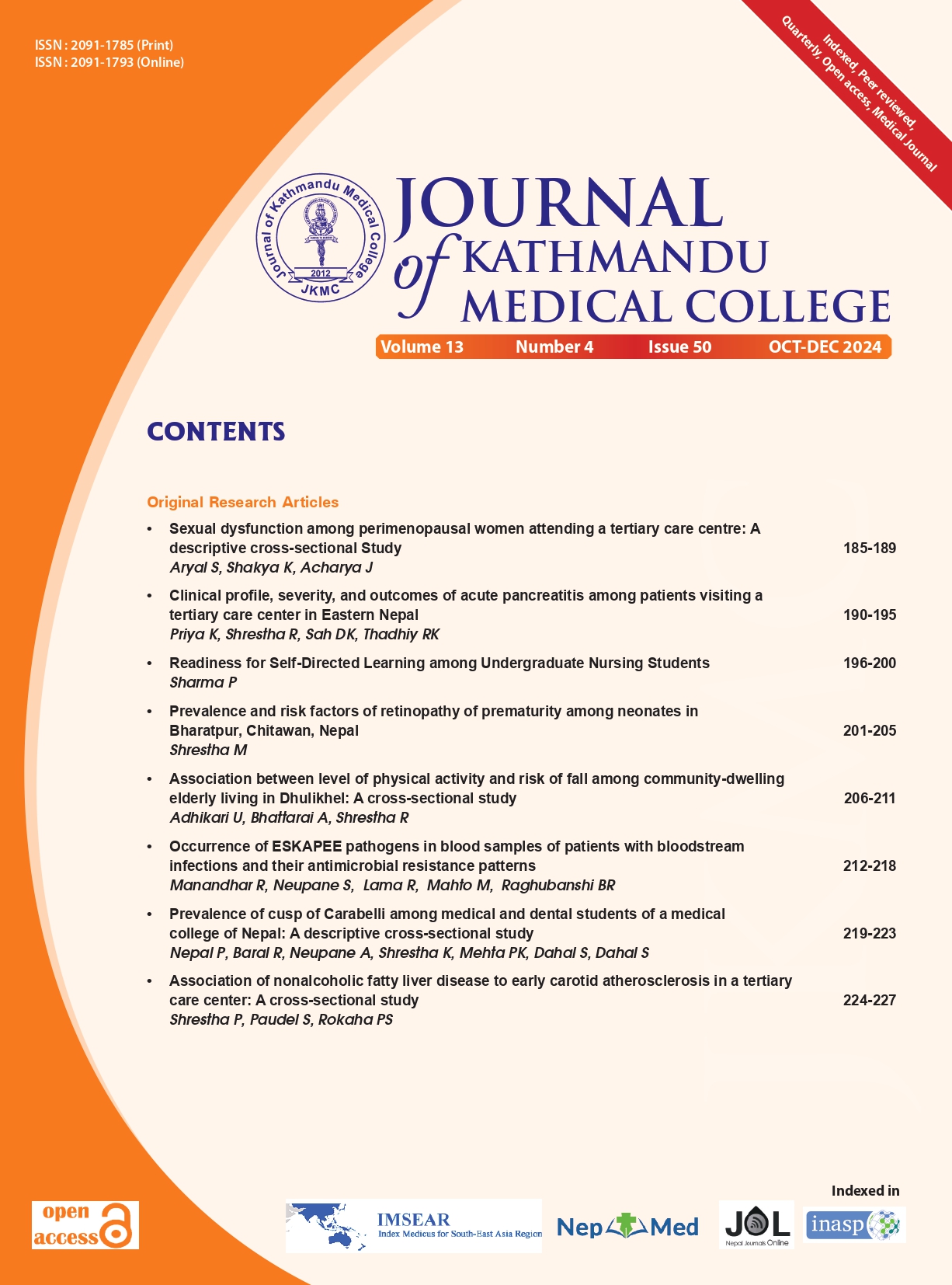
Keywords
Critical Care
Disease severity
Eastern Nepal
Outcomes
Modified CT Severity Index
How to Cite
Abstract
Introduction: Acute pancreatitis (AP) is a common gastrointestinal emergency with variable clinical presentation and outcomes. Severity indices such as the Modified CT Severity Index are important tools for predicting complications and outcomes.
Objective: To evaluate the clinical profile, severity and outcomes of patients with acute pancreatitis at a tertiary care center in Eastern Nepal.
Methodology: A descriptive cross-sectional study was conducted at Nobel Medical College Teaching Hospital, Biratnagar over a period of one year among 90 patients using consecutive sampling. Patients aged ≥18 years fulfilling at least two of these criteria: typical abdominal pain, ≥3 times elevated serum amylase/lipase, or imaging features of acute pancreatitis were included. Data were analyzed using IBM SPSS Statistics for Windows version 25 with descriptive statistics to summarise baseline characteristics and chi-square or Fisher’s exact tests to see the associations between disease severity and outcomes.
Results: The mean age of patient was 44.8 ± 15.9 years, with a male predominance 51 (57%). Alcohol 39 (43%) and gallstones 30 (33%) were the leading causes. Based on the Modified CT Severity Index, 13 (20%) of cases were mild, 38 (58%) moderate, and 15 (23%) severe. Complications occurred in 42 (47%) of patients more than half those were peripancreatic fluid collection. Overall mortality was 5 (6%,) all within the severe group. Disease severity showed a significant association with mortality (p < 0.001).
Conclusion: Acute pancreatitis in Eastern Nepal predominantly affects middle-aged males. A substantial proportion present with moderate-to-severe disease and notable mortality, underscoring the need for early severity assessment and improved critical care facilities.
References
Ghiță AI, Pahomeanu MR, Florescu DN. Epidemiological trends in acute pancreatitis: A retrospective cohort in a tertiary center over a seven-year period. World Journal of Methodology.2023;13(3):118–26. [ Full Text | DOI]
Gautam AK, Dewan KR, Shrestha R,KC V. Clinical Profile and Outcome of Acute Pancreatitis in a Tertiary Health Care Center of Nepal. Journal of College of Medical Sciences-Nepal. 2023;219(3):313–9. [ Full Text | DOI]
Haffar S, Bazerbachi F, Garg S, Lake JR,Freeman ML. (2015). Acute pancreatitis associated with acute hepatitis E: A systematic review. Pancreatology.2025;15(3) :321–6. doi: 10.1016/j. pan.2015.05.460. [PubMed | Full Text | DOI]
Bhattarai S,Gyawali M. Clinical profile and outcomes in patients with acute pancreatitis attending a teaching hospital at Gandaki province, Nepal. Journal of College of Medical Sciences-Nepal, 2020;16(1):5– 10. [Full Text | DOI]
Agrawaal KK, Raghubanshi P, Bohaju A, Acharya J. Acute Kidney Injury among Patients Visiting the Nephrology Unit in a Tertiary Care Centre: A Descriptive Cross-sectional Study. JNMA J Nepal Med Assoc. 2022;60(256):991-4. [PubMed | Full Text | DOI]
Yewale R,Chand N, Ramakrishna BS. Prediction of Severity Outcomes in Acute Pancreatitis: An Odyssey in Eternal Evolution. Gastroenterology, Hepatology and Endoscopy Practice 2022;2(4):143-51. [Full Text | DOI]
Metri A, Bush N, Singh VK. Predicting the severity of acute pancreatitis: Current approaches and future directions. Surg Open Sci. 2024;19:109-17. [Full Text | DOI]
Parveen S, Singh SJ, Dhar N, Nazir S, Sharma A, Mir TA et al. Increase in acute pancreatitis, especially gallstone related, as the cause for emergency admissions: Temporal trend from Kashmir, India. Indian J Gastroenterol. 2024. [PubMed | Full Text | DOI]
Lee PJ, Papachristou GI. New insights into acute pancreatitis. Nat Rev Gastroenterol Hepatol 2019;16:479–96. [PubMed | Full Text | DOI]
Szatmary P, Grammatikopoulos T, Cai W. Acute Pancreatitis: Diagnosis and Treatment. Drugs 2022;82:1251–76. [PubMed | Full Text | DOI]
Mederos MA, Reber HA,Girgis MD. Acute Pancreatitis: A Review. JAMA. 2021;325(4):382–90. [PubMed | Full Text | DOI]
Adeniran E, Yadav D, Pandol SJ, Papachristou GI, Buxbaum JL, Pisegna JR et al. Intense and Sustained Alcohol Consumption Associated with Acute Pancreatitis Warrants Early Intervention. Gastro Hep Adv. 2023;3(1):61-3. [PubMed | Full Text | DOI]
Tenner S, Baillie J, DeWitt J, Vege SS. American College of Gastroenterology guideline: management of acute pancreatitis. Am J Gastroenterol. 2013;108(9):1400– 15. doi: 10.1038/ajg.2013.218. [PubMed | Full Text | DOI]
Johnson CD, Abu-Hilal M. Persistent organ failure during the first week as a marker of fatal outcome in acute pancreatitis. Gut. 2004;53(9):1340–4. [ Full Text | DOI]
Banks PA, Bollen TL, Dervenis C. Classification of acute pancreatitis—2012: revision of the Atlanta classification and definitions by international consensus. Gut. 2013;62(1):102-11. [ Full Text | DOI]
Garg PK, Singh VP. Organ failure due to systemic injury in acute pancreatitis. Pancreatology. 2019;19(5):675– 81. doi: 10.1053/j.gastro.2018.12.041. [PubMed | Full Text | DOI]
Wu BU, Johannes RS, Sun X, Tabak Y, Conwell DL, Banks PA. The early prediction of mortality in acute pancreatitis: a large population-based study. Gut. 2008;57(12):1698–703. [PubMed | Full Text | DOI]
Singh VK, Wu BU, Bollen TL, Repas K, Maurer R, Johannes RS et al. A prospective evaluation of the bedside index for severity in acute pancreatitis score in assessing mortality and intermediate markers of severity in acute pancreatitis. Am J Gastroenterol. 2009;104(4):966-71. [PubMed | Full Text | DOI]
Mounzer R, Langmead CJ, Wu BU, Evans AC, Bishehsari F, Muddana V et al. Comparison of existing clinical scoring systems to predict persistent organ failure in patients with acute pancreatitis. Gastroenterology. 2012;142(7):1476-82. [PubMed | Full Text | DOI]
Uhl W, Warshaw A, Imrie C, Bassi C, McKay CJ, Lankisch PG et al. International Association of Pancreatology. IAP Guidelines for the Surgical Management of Acute Pancreatitis. Pancreatology. 2002;2(6):565-73. [PubMed | Full Text | DOI]